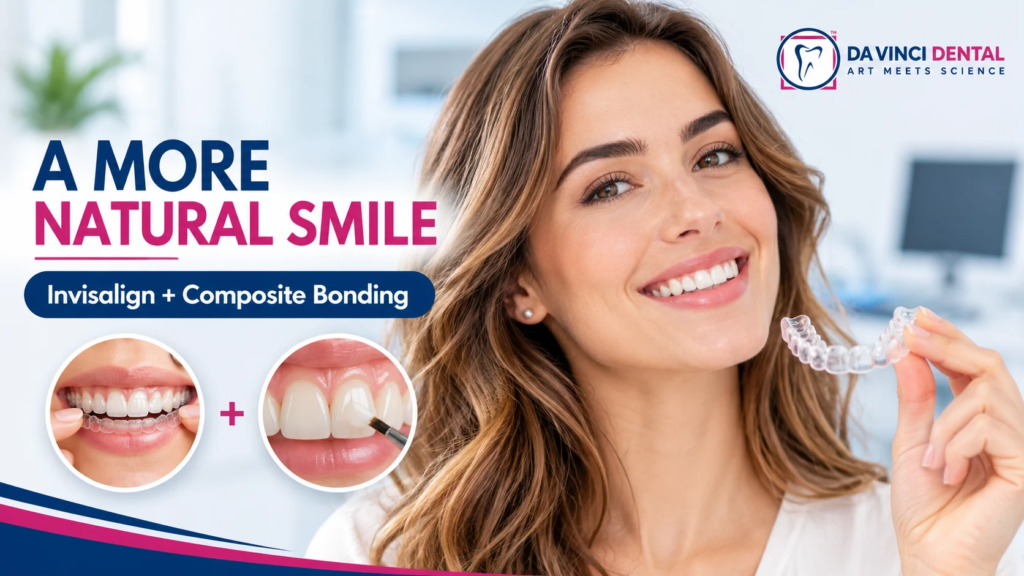
Invisalign + Composite Bonding in Dublin: Is This the Ultimate Natural Smile Makeover for 2026?
There is a big difference between wanting a “perfect” smile and wanting a smile that simply looks like the best version of your own.
In 2026, more patients are asking for the second option.
They want straighter teeth, better proportions and a cleaner-looking smile, but they do not necessarily want dramatic veneers or a result that looks overly manufactured. That change in preference is one reason the combination of Invisalign and composite bonding has become such an interesting option for anyone considering a smile makeover Dublin.
The idea is straightforward. Invisalign moves the teeth into a better position. Composite bonding then deals with some of the finer cosmetic details, such as small chips, uneven edges, minor gaps or tooth proportions.
Rather than asking one treatment to solve every cosmetic concern, the two treatments can complement each other.
For the right patient, that can create a very natural-looking result.
At Da Vinci Dental, smile design is not simply about making teeth look whiter or straighter. The aim is to look at how tooth position, shape, proportions and the wider smile work together before deciding what treatment makes sense.
So, could Invisalign plus bonding be the right natural smile makeover Dublin option for you?
Let us look at what the combination actually involves.
Why Invisalign and Composite Bonding Work So Well Together
Think of a smile makeover as a renovation.
Before you start changing the finishing details, you need the structure in the right place.
That is where Invisalign comes in.
Clear aligners gradually move teeth into planned positions. Depending on the case, they may help improve crowding, spacing, rotation and other alignment concerns.
Once the teeth are positioned more favourably, composite bonding can concentrate on shape.
This matters because a tooth can be perfectly healthy but still look slightly short, uneven, chipped or disproportionate beside neighbouring teeth.
Used carefully, bonding can refine those details without trying to compensate for significant tooth misalignment.
That sequence can make a major difference.
Instead of building composite material onto badly positioned teeth just to make them appear straighter, the teeth are moved first. Cosmetic work can then be more conservative.
It is one of the reasons people researching teeth straightening Dublin increasingly look beyond orthodontics alone and consider how their smile will look after alignment is complete.
What Does Invisalign Actually Change?
Invisalign uses a series of custom-made clear aligners to gradually move your teeth.
Unlike traditional fixed braces, the aligners are removable. That can make eating, brushing and social situations easier for many adults.
But the main benefit is not simply that the aligners are discreet.
It is the control they can offer when treatment is properly planned.
If you have overlapping teeth, small gaps or teeth that sit at awkward angles, correcting their position can change much more than the straightness of your smile. It can also improve how balanced your teeth appear when you speak or smile.
Patients considering adult orthodontics Dublin often have a slightly different goal from teenage orthodontic patients.
You might already have a career, social commitments and a lifestyle that makes visible braces less appealing. You may also be thinking beyond alignment and asking questions such as:
Will my teeth look even afterwards?
Will I still have gaps because of their shape?
What happens to chipped edges?
Will the final smile suit my face?
Those are sensible questions because orthodontics changes position, not necessarily tooth shape.
This is where composite bonding may enter the treatment plan.
What Is Composite Bonding?
Composite bonding is a cosmetic dental procedure in which tooth-coloured composite material is carefully applied and shaped to alter the appearance of a tooth.
It can be useful for improving concerns such as:
- Small chips
- Uneven tooth edges
- Minor gaps
- Slight differences in tooth length
- Irregular tooth shapes
- Small areas that affect overall smile symmetry
For patients researching composite bonding Dublin, one of its biggest attractions is that the treatment can often be relatively conservative compared with more extensive restorative options.
The objective should not be to make every tooth identical.
Natural teeth are not identical.
They have slight variations in shape, translucency and proportion. Good cosmetic dentistry respects those characteristics rather than erasing them.
That is particularly important when the goal is a natural smile makeover Dublin rather than an obvious cosmetic transformation.
Why Straighten First and Bond Afterwards?
This is probably the most important point in the entire treatment concept.
Suppose your front teeth overlap slightly and one lateral tooth looks noticeably smaller than the others.
You might be tempted to use bonding alone to disguise everything.
But adding material to teeth that are already crowded can sometimes make them appear bulkier rather than more balanced.
A different approach would be to align the teeth first.
Once they are in better positions, the dentist can see exactly what cosmetic concerns remain.
Perhaps the gap disappears completely.
Perhaps the smaller tooth only needs a subtle amount of composite.
Perhaps no bonding is needed on some teeth at all.
That is the advantage of planning your smile makeover Dublin as a complete journey rather than choosing individual treatments in isolation.
Move what needs moving.
Then refine what genuinely needs refining.
The finished result can feel much less artificial.
Who Might Consider Invisalign Plus Composite Bonding?
The combination will not be necessary for everyone.
Some patients complete Invisalign treatment and are completely satisfied with their smile without any bonding.
Others may have naturally straight teeth and require only minor cosmetic work.
However, the combined approach may be worth discussing if you have both alignment and shape concerns.
You might be a potential candidate if you have:
Mild to Moderate Crowding
Teeth that overlap or sit slightly out of line may benefit from orthodontic movement before cosmetic refinement.
Small Gaps
Invisalign may be used to redistribute or close spacing. Bonding can then help refine the final proportions where appropriate.
Chipped Front Teeth
Alignment may improve tooth position while bonding repairs the appearance of small chips or worn edges.
Uneven Tooth Lengths
Some people have naturally shorter lateral teeth or uneven incisal edges. After alignment, carefully planned bonding may create better visual balance.
A Smile That Feels “Almost Right”
This is surprisingly common.
Your teeth may not need extensive cosmetic dentistry, but a combination of subtle alignment and minor reshaping could improve the overall smile considerably.
A consultation is the best way to determine whether orthodontics, bonding or another cosmetic teeth treatment Dublin option is appropriate.
What Makes a Natural Smile Makeover Look Natural?
The word “natural” gets used constantly in cosmetic dentistry, but it should mean something.
A natural-looking smile should suit your face.
Tooth width, tooth length, gum display, smile line and facial proportions all influence the final appearance.
If every tooth is made extremely white, perfectly square and exactly the same length, the result may attract attention for the wrong reasons.
A carefully planned smile makeover Dublin takes more than tooth colour into account.
It considers questions such as:
Does the smile follow the natural curve of the lower lip?
Are the central teeth proportionate?
Do the side teeth transition naturally?
Is the tooth shape appropriate for the patient’s facial characteristics?
How much tooth shows when the patient speaks?
Do the changes still look believable at conversational distance?
These smaller details often separate good cosmetic dentistry Dublin from cosmetic work that simply looks obvious.
What Can You Expect From the Treatment Journey?
Every smile is different, so there should never be a one-size-fits-all treatment sequence.
A typical Invisalign and bonding journey, however, may involve several stages.
Stage 1: Consultation and Smile Assessment
The starting point should be a proper assessment.
Your dentist needs to understand what bothers you about your smile and what you actually want to change.
Photographs, scans and other diagnostic information may be used to assess tooth position, bite and proportions.
Do not be afraid to say that you want subtle changes.
A cosmetic consultation is not a commitment to dramatic dentistry.
Stage 2: Orthodontic Planning
If alignment is required, your treatment can be planned around the tooth movements needed to improve your smile and bite.
This is where teeth straightening Dublin becomes part of a broader cosmetic plan rather than a separate procedure.
Stage 3: Invisalign Treatment
You progress through your prescribed aligners while your dental team monitors movement.
Consistency matters here.
Clear aligners only work effectively when they are worn as instructed.
Stage 4: Reviewing the Smile
Once alignment is complete, the smile is reassessed.
This is a valuable stage because you may discover that you need less cosmetic treatment than you originally expected.
Stage 5: Composite Bonding
If bonding is still appropriate, composite material can be shaped and polished to improve selected teeth.
The emphasis should be on refinement rather than unnecessary alteration.
Is Invisalign Plus Bonding Better Than Veneers?
Not necessarily.
“Better” depends entirely on the problem being treated.
Veneers can be an excellent solution in the right situation, particularly where tooth colour, shape or more significant aesthetic concerns need to be addressed.
But they are not automatically the right choice for every smile.
If your main concerns are crooked teeth plus a few small shape imperfections, orthodontics followed by conservative bonding may provide the result you are looking for without relying on veneers to disguise tooth position.
This is why treatment planning matters so much in cosmetic dentistry Dublin.
The right question is not:
“What is the best cosmetic dental treatment?”
It is:
“What is the most appropriate treatment for my teeth and my goals?”
That conversation can save you from choosing more treatment than you actually need.
How Long Will the Results Last?
Both orthodontic and cosmetic results require maintenance.
After Invisalign, retainers are normally necessary to help maintain the new tooth positions. Teeth naturally have a tendency to shift over time, which is why retention forms an important part of orthodontic care.
Composite bonding also needs looking after.
Habits such as biting pens, chewing ice or using your teeth to open packaging can damage bonded edges.
Regular dental examinations and good daily oral hygiene help your dentist monitor both the natural teeth and the bonded areas.
Bonding may eventually require polishing, repair or replacement depending on wear, habits and individual circumstances.
A smile makeover should therefore be viewed as something you maintain, not simply something you finish.
How Much Does Invisalign and Composite Bonding Cost in Dublin?
There is no useful single price for the combination because two apparently similar smiles can require very different amounts of treatment.
The cost can depend on:
- The complexity of orthodontic movement
- Treatment duration
- The number of teeth requiring bonding
- The amount of composite required
- Additional dental treatment needed beforehand
- The final cosmetic goals
Da Vinci Dental currently offers clear-aligner and bonding treatments, but the most sensible approach is to obtain a personalised treatment plan and current quotation rather than choosing treatment based on an advertised headline price alone.
A cheaper plan is not necessarily better value if it does not address the underlying problem.
Likewise, the most extensive plan is not automatically the best.
Good smile design is often about knowing when to do less.
Why Start With a Smile Consultation?
You may arrive convinced that you need bonding on eight teeth.
After assessment, you might discover that alignment plus bonding on only two teeth would achieve the effect you want.
Or you may think Invisalign is necessary when a much smaller cosmetic adjustment could be enough.
That is why consultation comes before treatment.
At Da Vinci Dental, the conversation can start with what you see when you look in the mirror.
Maybe one tooth sits behind another.
Maybe the front edges look uneven in photographs.
Maybe you avoid smiling broadly because a gap catches your eye.
These may sound like small details, but if you notice them every day, they matter to you.
The purpose of good smile planning is not to persuade you into the most procedures. It is to work out which changes actually contribute to the result.
Is Invisalign + Composite Bonding the Ultimate Smile Makeover for 2026?
For some patients, it could come remarkably close.
Not because it is the newest or most fashionable option, but because it follows a logical principle.
Correct the position first.
Refine the shape second.
Preserve the character of the smile.
The combination can be especially attractive for adults who want a noticeable improvement without wanting their teeth to look obviously “done”.
If that describes what you are looking for, booking a smile assessment can help you understand what is genuinely possible.
Your ideal smile makeover Dublin may involve Invisalign and bonding. It may involve only one of them. It could involve a completely different plan.
The important thing is that the treatment should be designed around your teeth, your face and the smile you actually want to live with.
Ready to explore your smile options? Contact Da Vinci Dental to arrange a consultation and discover which combination of orthodontic and cosmetic treatments could suit your smile.
FAQs
1. Can Invisalign and composite bonding be used together?
Yes, Invisalign and composite bonding can be combined when a patient has both tooth-position and tooth-shape concerns. Invisalign can first move teeth into more suitable positions, while bonding may then be used to improve small chips, gaps, uneven edges or tooth proportions. Your dentist will need to assess whether both treatments are appropriate for your case.
2. Should composite bonding be done before or after Invisalign?
In many cases, cosmetic bonding is considered after Invisalign because the teeth can first be moved into their planned positions. This allows the dentist to see which cosmetic concerns remain once alignment is complete. There are exceptions, so the correct sequence should be determined during treatment planning.
3. How natural can a smile makeover with Invisalign and bonding look?
A well-planned natural smile makeover Dublin should complement your existing facial and dental characteristics rather than make every tooth look identical. Careful attention to shape, length, proportions and tooth position can help create a result that looks polished without appearing overly artificial.
4. Is composite bonding suitable for every tooth after Invisalign?
No. Some patients may require bonding on only one or two teeth, while others may not need it at all. Bonding is generally used to address specific cosmetic concerns such as small chips, shape differences or uneven edges. The number of teeth treated should be based on your individual smile design.
5. How do I know if I need Invisalign, bonding or both?
The best way to decide is through a dental and smile assessment. If tooth position is the main issue, Invisalign may be appropriate. If your teeth are already well aligned but have small shape concerns, bonding may be enough. When both alignment and cosmetic proportions need attention, a combined smile makeover Dublin plan may be considered.