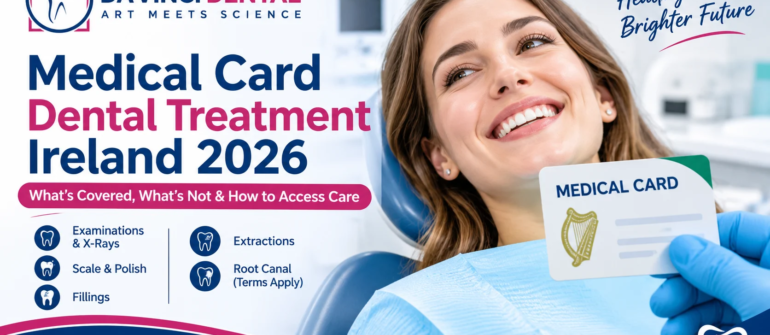
Dental treatment can become expensive surprisingly quickly. A tooth that only feels slightly sensitive today can turn into severe pain, an infection or an extraction if it is ignored for too long. For people trying to manage household costs, the first question is often not simply, “What treatment do I need?” It is, “Will my medical card cover it?”
If you are looking for dental treatment on medical card in Ireland in 2026, the answer depends on the treatment you require, your eligibility and whether the dentist you attend participates in the relevant HSE scheme.
The good news is that medical card holders over the age of 16 can access a defined range of dental services through the Dental Treatment Services Scheme, commonly known as the DTSS. The HSE confirmed in January 2026 that eligible medical card holders can access dental examinations and certain treatments through dentists contracted under the scheme.
Understanding what is included before you book can save time, reduce uncertainty and help you make better decisions about your oral health.
At Da Vinci Dental, we believe patients should understand their choices clearly before treatment begins, particularly when costs and public dental entitlements are involved.
What Is the Dental Treatment Services Scheme?
The dental treatment services scheme is an HSE programme that gives eligible medical card holders access to certain dental treatments through participating private dentists.
It is important not to confuse it with the Dental Treatment Benefit Scheme, sometimes called the PRSI dental scheme. The Treatment Benefit Scheme is linked to qualifying PRSI contributions, whereas the DTSS is designed for qualifying medical card holders.
According to the HSE, the DTSS applies to current medical card holders aged over 16. Patients must receive treatment from a dentist participating in the scheme.
That distinction matters.
Having a medical card does not automatically mean that every dentist or every dental procedure will be available free of charge. Before beginning treatment, check:
- Whether your medical card is currently valid
- Whether the dentist participates in the DTSS
- Whether the treatment you need falls within the scheme
- Whether prior HSE approval is required
- Whether any additional treatment will need to be paid for privately
A little checking at the beginning can prevent unpleasant surprises later.
What Dental Treatment on Medical Card Is Covered in 2026?
The HSE’s January 2026 guidance provides a useful picture of the current DTSS entitlement.
In one calendar year, eligible patients may access the following services.
Dental Examination and Necessary X-Rays
A dental examination is one of the most valuable benefits available through the scheme.
During an examination, the dentist can assess your teeth, gums and general oral condition. Necessary X-rays may also be included where clinically required.
This is important because many dental problems develop before obvious pain appears. Decay, gum problems and infections can progress quietly.
Finding them early may mean simpler treatment and a lower overall dental treatment cost.
Scale and Polish
Eligible medical card patients can also receive a scale and polish under the DTSS.
Professional cleaning removes deposits that normal brushing cannot always shift effectively. It can form an important part of maintaining healthy teeth and gums, particularly for people prone to tartar build-up.
Do not wait until your teeth feel uncomfortable before thinking about preventive care. Routine attention can help prevent smaller concerns from becoming expensive dental problems.
Two Fillings Where Clinically Necessary
The 2026 HSE information states that two restorations, or fillings, may be provided in a calendar year when clinically necessary.
Fillings are used to repair teeth damaged by decay or other forms of tooth structure loss. Treating a cavity earlier can sometimes help preserve more of the natural tooth.
If several teeth need treatment, however, it is worth discussing priorities with your dentist. Coverage limits mean that some additional restorative work may need to be considered separately.
Dental Extractions
The DTSS currently permits extractions where necessary, with the HSE stating that as many as clinically required can be accessed under the scheme.
Extraction may be considered when a tooth cannot reasonably be saved, severe decay is present or infection creates a risk to surrounding tissues.
A good dental consultation should still focus on whether a tooth can be preserved before extraction is chosen.
Root Canal Treatment for Front Teeth
Root canal treatment is available through the scheme in certain circumstances, but the current entitlement is restricted to front teeth.
This is an important limitation for anyone searching for affordable dental treatment after being told that a back tooth requires root canal therapy.
If the required treatment falls outside DTSS coverage, ask your dentist about the available alternatives and the expected cost before making a decision.
Denture Repairs and Dentures
Denture repairs are included, while dentures themselves may be available subject to prior approval.
Patients considering dentures should therefore avoid assuming approval is automatic. Your dentist can explain the clinical requirements and whether an application needs to be made before treatment proceeds.
What Is Not Normally Covered by a Medical Card?
One of the biggest misunderstandings around dental treatment on medical card is the belief that the card covers every type of dental procedure.
It does not.
The DTSS provides a defined package of care rather than unlimited dental treatment.
Treatments that are not part of the standard services listed by the HSE may need to be paid for privately. These can include many cosmetic, orthodontic and advanced restorative procedures.
Depending on your circumstances, examples may include:
- Teeth whitening
- Cosmetic veneers
- Composite bonding performed for purely aesthetic reasons
- Dental implants
- Adult orthodontic treatment
- Clear aligners
- Cosmetic smile makeovers
- Root canal treatment on posterior teeth
- Certain crowns, bridges or advanced restorative procedures
Coverage and clinical circumstances can change, so always ask the dentist or HSE before assuming that a particular treatment is excluded or included.
This is where a clear treatment plan becomes useful.
Rather than focusing only on whether something is “free”, ask what treatment is clinically necessary now, what can safely wait and what options are available if a procedure falls outside the scheme.
How to Access Dental Treatment on Medical Card
The process does not need to be complicated.
1. Check That Your Medical Card Is Valid
The DTSS is available to current medical card holders over 16.
Make sure your card details and eligibility are up to date before arranging treatment.
2. Find a Dentist Participating in the DTSS
Not every private dentist participates in the dental treatment services scheme.
The HSE states that eligible patients can obtain care from dentists on the DTSS list, which is available through local HSE dental services and the Primary Care Reimbursement Service.
Always confirm participation directly before attending specifically for medical-card treatment.
3. Explain What Is Bothering You
Do not simply book a cleaning when the real problem is persistent toothache, swelling or a broken tooth.
Tell the practice what you are experiencing. That allows the dental team to determine how quickly you should be assessed.
If you have significant pain, swelling, dental trauma or a badly damaged tooth, you may require emergency dental treatment rather than a routine appointment.
4. Get a Proper Assessment
Your dentist needs to examine your mouth before deciding which treatment is appropriate.
This matters because two people with similar symptoms may need completely different care.
A painful tooth might require a filling in one patient, root canal treatment in another and extraction in a third.
5. Ask About Costs Before Additional Treatment
If part of your treatment is outside medical-card coverage, ask for the dental treatment cost before proceeding.
Patients should feel comfortable asking:
“Is this covered by my medical card?”
“Will I need to pay anything?”
“Is prior approval required?”
“What alternatives do I have?”
“What happens if I delay this treatment?”
Clear answers make it easier to make a decision based on your dental health as well as your budget.
What If the Treatment You Need Is Not Covered?
This is where people sometimes postpone treatment completely.
That can be a costly mistake.
A procedure not being covered by the medical card does not necessarily mean you should ignore the problem. Delaying care can allow a manageable issue to become more complicated.
Suppose a small area of decay progresses until the nerve becomes infected. Treatment could move from a straightforward restoration to root canal therapy or even extraction.
If DTSS does not cover the care you require, ask about private options and whether treatment can be prioritised in stages.
A professional dental treatment centre should explain what is urgent, what is elective and what can reasonably be planned for later.
That approach makes affordable dental treatment less about finding the cheapest short-term option and more about avoiding larger dental problems in the future.
Medical Card Dental Care and Private Dentistry Can Work Side by Side
Public dental entitlement and private dental care are not necessarily competing choices.
Your medical card may cover certain essential treatments, while you may decide to privately fund care that falls outside the DTSS.
For example, a patient may use their eligible scheme benefits for basic oral care but later choose cosmetic dentistry, orthodontics or another service privately.
The key is knowing exactly where one form of care ends and another begins.
Da Vinci Dental’s Dublin practice offers orthodontic dentistry, cosmetic dentistry, cleaning and prevention, general dentistry and dental emergency services. The practice operates by appointment from its North Circular Road location in Dublin 7.
If you are considering treatment at Da Vinci Dental, contact the practice directly to discuss the service you need, current treatment options and costs. If you specifically want treatment through the medical card scheme, confirm current DTSS participation and eligibility before booking, as participation should never be assumed.
Do Not Let Cost Questions Keep You Away From the Dentist
Dental problems rarely become easier because they have been ignored.
If cost is your concern, start by finding out what you are actually entitled to.
For eligible patients, dental treatment on medical card can provide access to important services including examinations, cleaning, clinically necessary fillings, extractions and certain other treatments.
For anything outside that entitlement, ask for clear pricing and a treatment plan.
At Da Vinci Dental, the aim is to help patients understand their options rather than leave them guessing about their teeth, their treatment or the likely cost.
Whether you are worried about toothache, overdue for a check-up or considering more comprehensive dental care, the most useful first step is usually the simplest one: arrange an assessment and find out what your mouth actually needs.
Contact Da Vinci Dental on 01 567 4470 or book an appointment to discuss your dental concerns and available treatment options.
FAQs
1. What dental treatment can I get on a medical card in Ireland in 2026?
Eligible medical card holders over 16 may access a dental examination with necessary X-rays, scale and polish, two clinically necessary fillings, required extractions, root canal treatment for front teeth, denture repairs and, subject to prior approval, dentures under the DTSS.
2. Is every dentist required to accept medical cards?
No. Dental treatment on medical card is provided through dentists contracted to participate in the Dental Treatment Services Scheme. You should confirm that the dentist participates in DTSS before arranging treatment under the scheme.
3. Does a medical card cover cosmetic dental treatment?
Cosmetic procedures such as whitening, aesthetic veneers and elective smile-makeover treatments are not included in the standard DTSS treatments currently listed by the HSE. Patients considering cosmetic care should ask their dentist about private treatment options and costs.
4. Does the medical card cover emergency dental treatment?
Certain clinically necessary treatments available under DTSS, including fillings and extractions, may be relevant when treating urgent dental problems. The exact treatment depends on your diagnosis, eligibility and the services covered by the scheme. If you have severe pain, swelling or dental trauma, contact a dentist promptly.
5. How can I find out my dental treatment cost if something is not covered?
Ask your dentist for a treatment plan before starting non-covered care. It should clarify what treatment is required, which services may be covered by your medical card and what private fees apply to anything outside the scheme. This makes it easier to budget and compare treatment options.